 Authored by:
Rebecca Weaver Rinehart
Preaward Specialist
University of Northern Iowa
Email: rebecca.rinehart@uni.edu
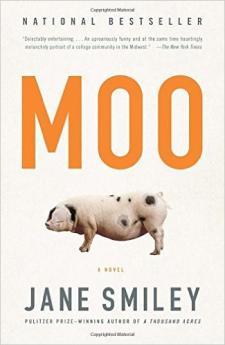 If there is a better satire on university life than Jane Smiley’s novel Moo, I have yet to find it. Set at a large state university in an anonymous Midwestern state, Moo traces the stories of various faculty, students, employees and administrators over the course of an academic year when the university is threatened by large budget cuts. The university grasps at the offer of research contracts from an unscrupulous billionaire, ultimately involving itself in disappointment and scandal.
Jane Smiley’s novels have been compared to Charles Dickens’, and Moo is a prime example, with a large number of characters who cross paths in surprising ways, and a mixture of humor and pathos. Even the characters’ names are reminiscent of his novels. (Smiley has also published an excellent short biography of Dickens). Smiley’s psychological characterizations, however, are more nuanced than Dickens’. Even most of the unlikeable characters are presented with a complexity that gains the reader’s sympathy, and none of the characters are beyond ethical reproach.
For those of us who are old enough to remember the dawn of email, this book hearkens back to a time when it was just about to transform our working lives. In Moo, only the secretaries - the most influential people on campus - are connected by computer network.
Few research administrators would recognize themselves in Smiley’s portrayal of Jack Parker, the university’s “federal grant specialist” and president’s right-hand man. They may have more sympathy than the average reader, however, with Elaine Dobbs-Jellinek, the associate vice-president in charge of corporate grants and contracts, when she tells a faculty member: “There are good ideas, lots of them, and then there are fundable ideas, fewer of those. Fundable ideas are better ideas” (p. 245). They may even acknowledge some truth in the assertion that “…grant money … seemed to enjoy its own company” (p. 122).
However, this all too familiar (and inaccurate) perception of facilities and administrative costs is likely to make us bristle: “Now the thing is, I know you guys skim a percentage right off the top…” (p. 72). And we may be thankful that institutions have more authority to approve proposal submissions and agreement terms than is portrayed in this novel: “The fact was that no faculty member needed … permission to seek or accept a grant. The provost’s office maintained the university guidelines on intellectual property and ethical research standards … but faculty members were officially assumed to be knowledgeable and responsible in these areas” (p.137).
Intellectual property specialists will find this novel particularly interesting. One story line is focused on a mysterious invention and its paranoid creator, another on a scientist who stokes a corporate bidding war for the rights to his future research.
Moo is a sprawling novel that brings its threads to satisfying or surprising conclusions, or rather to inflections in the characters’ lives that leave the reader imagining what might happen to them next. It’s also terrifically funny.
References:
Smiley, Jane. Charles Dickens: A Life. New York: Viking, 2002.
Smiley, Jane. Moo. New York: Alfred A. Knopf, 1995.
#insights#Membership